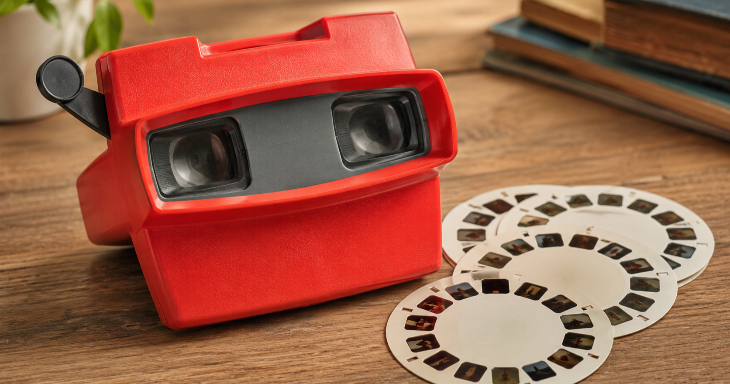
Which toy, first introduced in 1939 and later popular with kids in the 1960s, allowed users to view 3D images using circular picture reels?
The correct answer is View-Master. The handheld viewer used circular reels with paired images to create a 3D effect.
View-Master is the answer. Introduced in 1939 and associated with Sawyer’s photographic products, View-Master grew from William Gruber’s stereoscopic photography concept into a handheld viewer that used circular picture reels, with early scenic and educational views later giving way to children’s entertainment reels.
From Scenic Viewer to Toy Aisle Favorite
View-Master was not originally limited to children’s entertainment. Early reels often featured scenic travel views, landmarks, educational subjects, and photographic scenes that fit Sawyer’s background in visual products. Over time, the viewer became more strongly associated with children through story reels, television themes, movie tie-ins, and character-based sets.
How the 3D Reels Worked
The View-Master reel used paired images that created a three-dimensional effect when seen through the stereoscopic viewer. Each circular reel contained multiple image pairs, commonly arranged as seven 3D views. Looking through the device gave each scene depth, turning still photographs into a small private picture show.
Why View-Master Became Popular With Kids
View-Master’s appeal came from combining simple handheld use with the surprise of 3D images. Children could click through a reel one scene at a time, making it feel interactive without needing batteries, a screen, or complicated rules. By the 1960s, entertainment-themed reels helped make View-Master a classic toy as well as a photographic viewer.
Ready for another challenge?
Start a 10-question challenge and test your knowledge of classic toys, board games, puzzles, dolls, games, and childhood favorites.
Start the Challenge