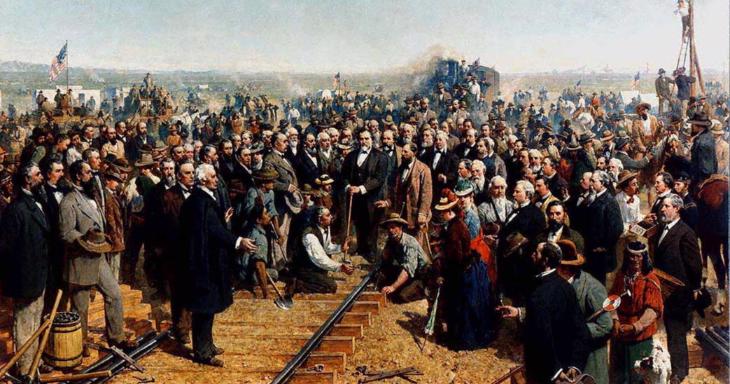

Which rail line, completed in 1869, linked America’s east and west coasts?
The correct answer is the Transcontinental Railroad. Completed in 1869 at Promontory Summit, it connected western rail lines with the eastern rail network.
The Transcontinental Railroad is the answer. The First Transcontinental Railroad was built by the Union Pacific and Central Pacific railroads, which met at Promontory Summit in Utah Territory, where the Golden Spike ceremony marked a new rail connection between long-distance travel, commerce, and settlement across the United States.
Where the Rail Lines Met
The two railroad lines met at Promontory Summit on May 10, 1869. The ceremony included the driving of the Golden Spike, a symbolic final spike that marked the completion of the coast-to-coast rail connection. The line did not mean one railroad company owned a single uninterrupted track from ocean to ocean, but it linked western rails with existing eastern rail networks.
Union Pacific and Central Pacific
The Union Pacific built westward from the central United States, while the Central Pacific built eastward from California. Construction relied on difficult and dangerous labor, including major contributions from Chinese railroad workers on the Central Pacific line. The expansion of the rail line was also tied to the displacement of Native peoples as tracks, towns, and federal power pushed deeper into the American West.
How the Railroad Changed Travel
Before the Transcontinental Railroad, cross-country travel often required wagon routes, stagecoaches, or long sea journeys around the continent or through Panama. The completed rail connection made coast-to-coast travel faster, more practical, and more reliable for passengers, freight, mail, and communication. In U.S. history, the rail line mattered because it strengthened trade, settlement, and federal control across the West while also carrying major human and environmental costs.
Ready for another challenge?
Start a 10-question trivia challenge and test your knowledge of presidents, founding documents, wars, railroads, landmarks, and historic events.
Start the Challenge