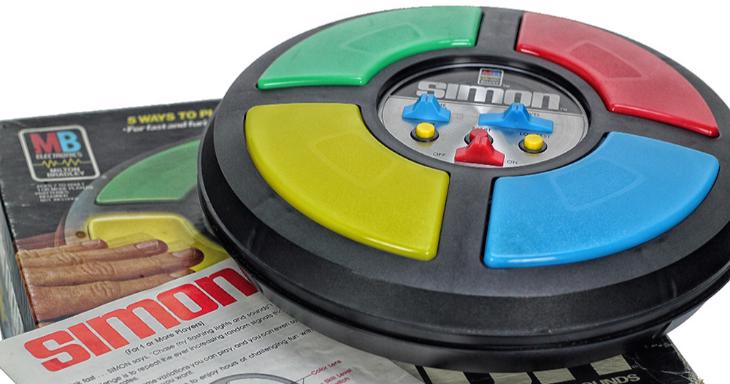
Which 1970s electronic memory game challenged players with lights and tones?
The correct answer is Simon. Introduced in 1978, it challenged players to repeat growing sequences of colored lights and tones.
Simon is the answer. Introduced by Milton Bradley in the late 1970s, Simon was an electronic memory game built around four colored buttons, each with its own light and tone, with Ralph H. Baer and Howard J. Morrison credited among the creators behind its pattern-recall design.
The Four-Button Pattern Challenge
Simon used a simple but demanding play pattern. The game flashed a sequence of colored lights and tones, and the player had to repeat the sequence by pressing the correct buttons in order. Each successful round added another step, turning the toy into a test of memory, timing, attention, and sound recognition.
Ralph Baer, Howard Morrison, and Milton Bradley
Ralph H. Baer and Howard J. Morrison are closely associated with the creation of Simon, which Milton Bradley brought to market as a late-1970s electronic toy. Its design stood out because it did not need a board, cards, dice, or written clues. The electronics handled the pattern, feedback, and increasing difficulty.
Why Simon Fit the Electronic Toy Era
Simon became one of the best-known electronic toys of its era because it combined very simple rules with lights, tones, and instant feedback. The four-button layout made the game easy to understand, while the growing sequences made it harder the longer play continued. Later versions kept the same basic idea because the original design was clear, compact, and strongly tied to electronic memory play.
Ready for another challenge?
Start a 10-question challenge and test your knowledge of classic toys, electronic games, board games, puzzles, and childhood favorites.
Start the Challenge